Transgender Horror: The Amazing Digital Circus and Die
WARNING: Spoilers for The Amazing Digital Circus and Die
June saw the month saw the release of conclusion of The Amazing Digital Circus and the sequel to Die, Die Loaded. Both are interesting examples of transgender horror, a genre that getting increasing attention lately. I've not seen I've Seen the TV Glow which is on my list. It overlaps with my reading of the Embodied Exegesis collection and Charlie Jane Anders' chilling "Don't Press Charges and I Won't Sue".
I feel the need to make a distinction here between transgender/queer horror that positions trans people as protagonists against powerful malevolent systems, vs. the tradition of queerphobic horror which positions trans people as evil perpetrators or deserving victims of violence (such as Silence of the Lambs). Here the mode of horror media is used to explore issue of isolation, trauma, and internalized transphobia for queer protagonists.
What do Digital Circus and Die have in common? They both feature characters who are trapped in a game world at the mercy of an emergent or "artificial" intelligence. The intelligence coerces them into games — ostensibly to help the players. However the game creator doesn't fully understand its audience, and the result is psychological torture and horror. And they both have trans characters that serve as a vehicle for exploring themes that are common but not unique to trans people.
In Digital Circus (see Wikipedia) characters are forced into the role of cartoon circus characters with the AI Caine as ringleader and game designer. Zooble is identified as a nonbinary person with body dysphoria trapped in a virtual body composed of interchangeable toy parts. In spite of this ability, none of the parts match their self image or each other. Zooble initially tries to withdraw from the games into apathy, which is later revealed to be dangerous. Within the world of the Circus, players without support undergo "abstraction" and become monsters.
Zooble develops a relationship with the depressed Gangle. Gangle's face is a comedy/tragedy mask with the comedy mask frequently broken. The relationship arc points to one of the primary tools for trans survival of adverse circumstances, mutual aid and support.
Zooble's contrast is Jax, who has the form of a cartoon rabbit. Where Zooble survives, Jax is a cautionary tale about the inability to escape cycles of abusive gender roles. He fully embraces the role of the trickster cartoon rabbit, doing violence to others when he thinks he can get a good gag out of it. He flips from brief moments of honesty and vulnerability to verbally abusive sarcasm to push others away. Of all the characters in the show, Jax is the closest to abstraction.
Jax's cautionary tale isn't revealed until the final episode. Jax is repeating the cycle of praise/abuse that was demonstrated by his parents. In addition, Jax is transgender and his singular attempt talk about his identity with his mother results in rejection and tragedy. (I use same pronouns as the text of the show.) His rejection of support from other people trapped in the circus leads to the abstraction of two of his friends.
One of my favorite themes in horror is how people succeed or fail to break cycles of violence, abuse, and dysfunction. Mike Flanagan is one of the top directors in this mode, tackling familial abuse, mental health, and sobriety. Similarly, in the classic Romero zombie movies the zombies serve as a trigger for human flaws to create tragedy. In this mode of horror, people get better, they get harder, or they break. Horror raises the stakes such that moral choices that normally break relationships can have fatal consequences. Jax ultimately is unable to recover from toxic masculinity and shame.
In Die, the game world is an emergent god representing two centuries of table-top role playing games from the Bronte family to the 21st century. Creators Kieron Gillen and Stephanie Hans dive into the use of ttrpgs to explore ideas that are difficult to discuss without the frame of fiction. A short blurb for the series is "Goth Jumanji," and the series lives up to the description.
Here, we have another questioning trans person, Ash. The players are pulled into into their game, first as teenagers and again 25 years later. As a teen, Ash is given the body of an idealized adult woman with the power to control others against their will. But as a teen, she's unprepared for a fantasy of dice and paper to be real. As an adult, Ash must deal with the consequences of the choices she made, including an unplanned pregnancy and reaction to how she abused her powers for political gain.
Die falls into the group of wish fulfillment horror. What you want in fantasy or eventually may not be what you can handle now. Or it might come with strings attached. This is true for all of the characters. Die puts Ash into a fictional ideal without fully understanding her own identity, and the role she takes on does not allow for the needed work. The gender expression becomes bound to the RPG power fantasy.
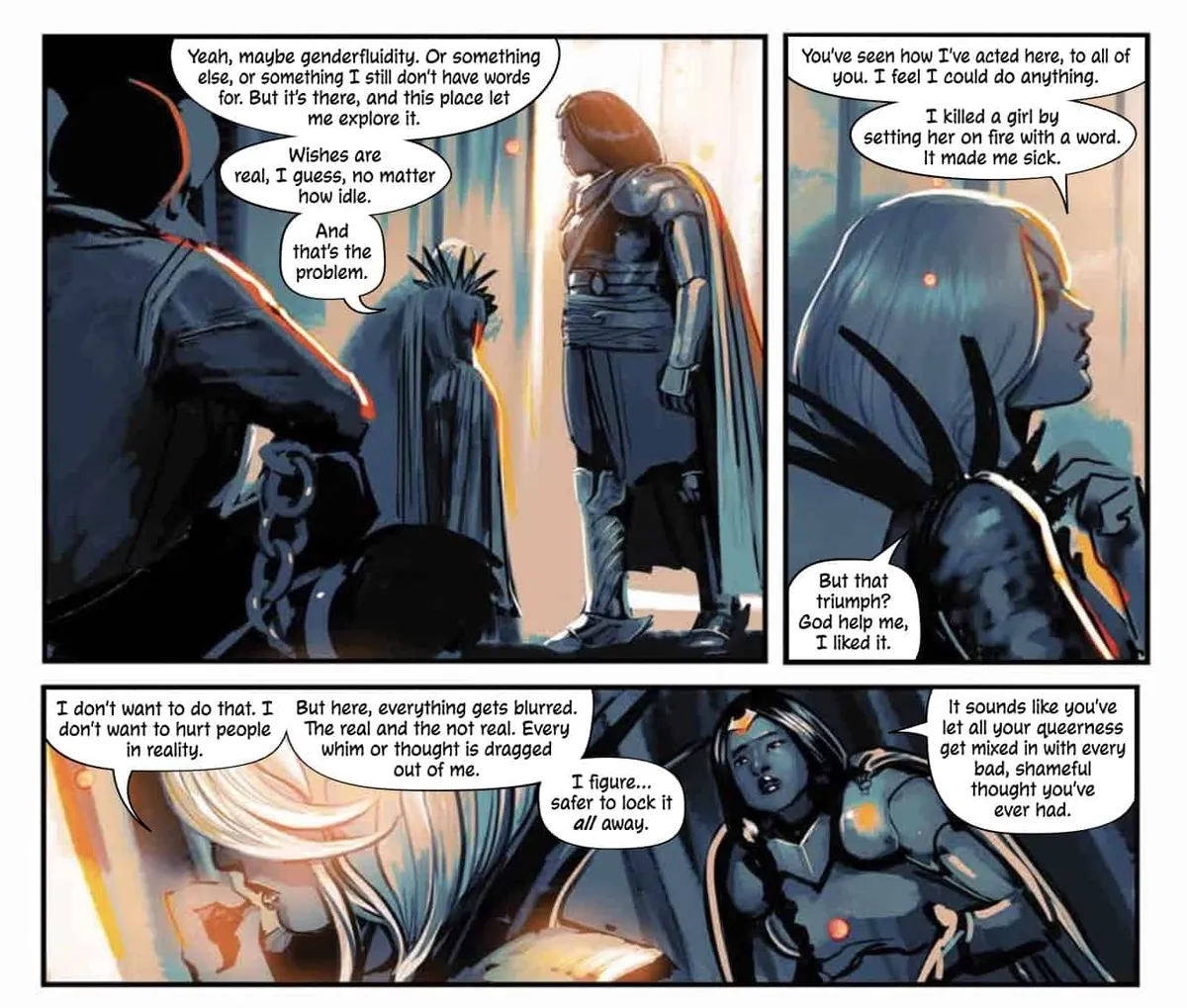
Returning to Earth, the party can't fully discuss what happened for fear others will be pulled into the same fantasy world. In Die, Ash suppresses the needs of her Earth identity. On Earth, Ash struggles to find the next steps for expressing her genderfluidity. Ash gets tied up in different roles, pushing her gender identity exploration aside.
In both Digital Circus and Die we have creators who theoretically want the best for their captive audience. Caine is a creative AI that initially creates adventures to entertain the circus. However most of the adventures include elements of physical danger and existential horror. A "cozy" restaurant sim has characters falling into deep fryers and strange time dilation.
Die mashes up influences from creators with their worst flaws and experiences. Tolkien's English fantasy world is locked in WWI trench warfare with German toy soldiers and Kriegspiel. Die's current "game master" is Ash's best friend, Saul. Saul says:
I wanted you to find yourself, Ash. You weren't at home in our world. I was 16 and I could tell it. But maybe you could be in a game I made for you? I wanted you to find you. (Die, issue 19)
Often systems are made to help us without our consent and without our influence. These systems can cause more harm than good. Both works highlight this by raising the stakes to the level of life and death.
Transgender horror is a mode of fiction that attempts to highlight the harms of structural or internalized transphobia by raising the stakes and centering on transgender protagonists. As a genre, it emphasizes that every moment of grace and self-acceptance is worth fighting for. In Die Ash has this monologue: (Die, issue 19)
You know, the whole The Lion, The Witch, and The Wardrobe. They went in there, had adventures, became kings and queens, became monsters.
We did that. I did that, more than most.
You know the thing about wardrobes? Wardrobe is just another word for "closet."
If you think about it, all of Narnia is in the closet. And eventually, you have to come out.
The place brings everything to the surface to be examined. That's what it tries to do. You learn from it ... you choose what to leave behind ... and then you choose what to take.
You don't get to tell me who I am.
Whatever it is, I decide.