Posthuman Societies for TTRPGs (version 0.2)
Posthuman Societies for TTRPGs
Human-centric science fiction doesn't mean everyone is the same. Posthuman societies can be just as weird and diverse as the classic aliens of Star Trek, Star Wars, and Babylon 5. Here are some information sheets for building characters for posthuman societies from various science fiction stories. I've included notes on the source material that inspired some of these. This is intended to be the start of homebrew rulemaking rather than a comprehensive sourcebook.
- Adaptations: A short list of traits with suggested game mechanics.
- Appearance, clothing, names: Optional notes on appearance, clothing, and names for fleshing out a characters.
- Ethos: Some common (but very optional) ethos ideas.
- Notes: A short discussion of primary and secondary inspirations for this character concept. These are based on my personal reading rather than an overview of the genre as a whole. Some ideas (such as clone families and military zombies) are ubiquitous but I'm most familiar with specific works.
- Character Questions: Powered by the Apocalypse-style prompts for character development.
Aquatics
Aquatic humans have adapted to live on sea worlds with minimal contact with dry land. They've used advanced biotechnology to modify themselves and their environment to a delicate balance. They live on rafts of aquatic vegetation that serve as farms for fish, crustaceans, and plants. Their culture prioritizes long-term environmental stewardship and they actively resist changes that threaten that balance. Key modifications include symbiotic bacteria to store oxygen, reduced hair, webbed fingers and toes, and increased body fat.
Adaptations
- Swimming: Aquatics are at home in the water. Aquatics experience no penalty performing complicated tasks while swimming or diving.
- Oxygen: Aquatics store additional oxygen in symbiotic bacteria and have additional adaptations to make the best use of what they have. Roll with advantage when facing danger due to lack of oxygen. This ability has a short recharge time.
- Hypothermia Resistance: Roll advantage when facing danger due to hypothermia.
Appearance
Webbed fingers and toes, no or minimal hair, variable blue-gray skin color, additional body fat.
Clothing
No clothing, swimming clothes, easily-removed clothing.
Ethos
Radical environmentalism
Names
Familiar names plus an epithet describing an emotional trait. Aquatics often choose names that are reminders of traits they want to improve: Bernin the Hungry, Golwa the Impatient, Wolg the Difficult.
Character Questions
- What is the key event that led to you leave your home on the floating islands?
- How does space compare to your oceans?
- What is something you've learned to accept from non-aquatic humans?
Notes
- Primary: Door into Ocean by Joan Sloczewski is my primary source for this version. Slonczewski's sharers are monogendered and ecofeminist.
- Secondary: Starfish by Peter Watts has aquatic humans engineered for deep-sea labor. Starfarers by Vonda McIntyre includes an aquatic culture of humans who live with whales.
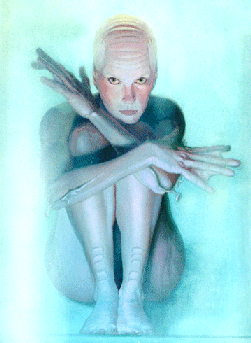
Image from Tor re-release edition via Slonczewski's study guide for the book
Clone Families
Clone families are groups that have been cloned from a single or a few individuals. Variations in development and experience give each member unique personalities and abilities. Motives for establishing a clone family can vary but many have a shared family identity surrounding a particular profession or set of skills. They may have a familial language of inside jokes and gestures. Clone families may include others by birth, adoption, or marriage. The existence of clone families may or may not be illegal in different parts of the galaxy.
In spite of being a "family," each member is unique with differences in behavior, mannerisms, apparent age, sexuality, gender, and beliefs.
Adaptations
- Extended Family: Members may not always get along, but they're still family to some degree. Social interactions with other clones are rolled with advantage.
- Skill Focus: Members are expected or encouraged to master a shared skill or profession.
- Impersonation: Some members can pass as each other, at least as far as outsiders are concerned.
Appearance
- Individually, members are indistinguishable from their home culture. As a group, members may choose to express their relationship with their family through hairstyle or bodyart.
Clothing
- Shared clothing style, individualized clothing style, uniform with personalized marker.
Ethos
- Shared ethos, rebellious ethos.
Names
- unique family name, serial number, typical name
Notes
Probably the most popular example are the clone troopers from Star Wars: The Clone Wars and Star Wars: The Bad Batch. Other sources:
- The Durona Group from Lois Bujold's Mirror Dance
- Orphan Black
- House of Suns by Alistair Reynolds
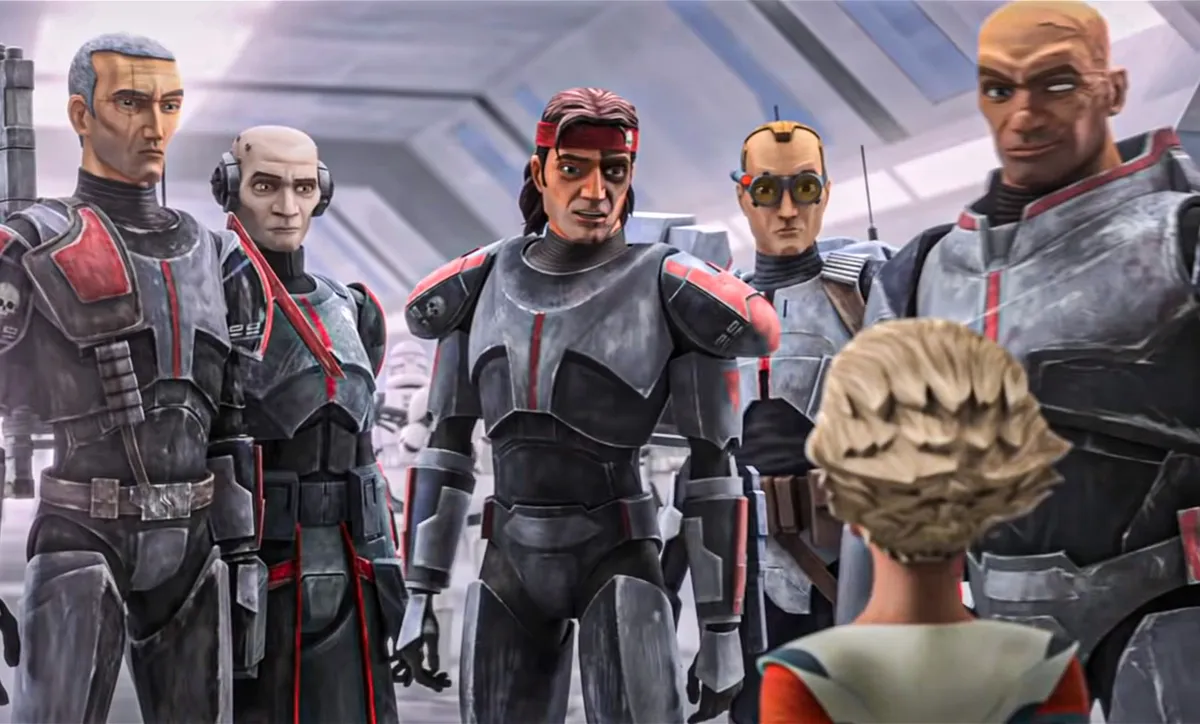
Still from Lucasfilm/Disney The Bad Batch.
Character Questions
- What do you have in common with your family? What separates you from your family?
- What is the origin story of your family?
Engineered Caste Societies
Caste societies use genetic engineering to create specialized castes. Some of these roles may include:
- Elites
- Government Managers
- Science/Technical
- Military
- Disposables: Slave labor for hazardous conditions
While a stratified society may be the designed intent of this posthuman culture, individuals may not act or identify according to their engineered roles. Individuals who try to escape the system or don't fit into it may be punished to different degrees.
Adaptations
- Role focus: Roll with bonus when Facing Danger or Securing an Advantage using one's role.
- (Optional) sterility: Individuals may be sterile depending on the caste rules.
Appearance
- Normal appearance, caste tattoo, physical caste trait (eye color, lack of hair)
Clothing
- Caste-identifying clothing, individualized clothing.
Ethos
Authoritarian, revolutionary.
Character Questions
- What changes have you had to make in living away from your home planet?
- What are your goals with respect to your home culture? Escape, reform, revolt, something else?
- What accidentally reminds you of your caste origins? How do you respond?
Notes
Primary inspiration comes from A Closed and Common Orbit by Becky Chambers. Pepper is a woman who escapes slave labor as a child. Other examples include Cetaganda by Lois Bujold. Caste system plotlines should be discussed during the lines and veils negotiation of a TTRPG session.
Military Zombies and Weapons
Zombies are soldiers who have had their free will, higher cognitive functions, and moral conscience temporarily or permanently disabled through the use of neurosurgery and other interventions. Compared to unmodified humans, they have higher reflexes and react without hesitation or restraint in combat situations. Tactical and strategic thinking are usually handled by other soldiers.
Weapons have been modified to think as part of a weapon system. A pilot might be modified to consider the aircraft to be part of their body, and a ground soldier modified to consider a rifle to be an extension of their arm. Humans with these mods get improved skill and reflexes without the cognitive cost of zombification. Weapons may experience bodily dysphoria when not operating as part of their weapon system.
Adaptations
- Combat Reflexes: Bonus to Face Danger when surprised by combat.
- Preferred Weapon: Take a bonus when Clashing with preferred weapon.
- Pain Tolerance: Defer Pay the Price for physical pain until immediately after combat.
Appearance
Visible modifications, cybernetics, military stance
Clothing
Clothing to accommodate hidden implants, ordinary clothing, military clothing
Character Questions
- What are your current feelings regarding being modified?
- Do you still have access to the weapons you were designed for? How does that affect you?
Notes
Peter Watts has discussed zombies in multiple stories including Echopraxia. Zombies are just one example of militarized neuroscience in his works. The ancillaries of Ancillary Justice by Ann Leckie and Murphy from Robocop are related works.
A primary source for weapons here is The Helicopter Story by Isobel Fall. In this story, militarized neuroscience manipulates gender dysphoria to create better helicopter pilots. Another story is "A Stick of Clay in the Hands of God is Infinite Potential" by Neon Yang centered on a mecha pilot.
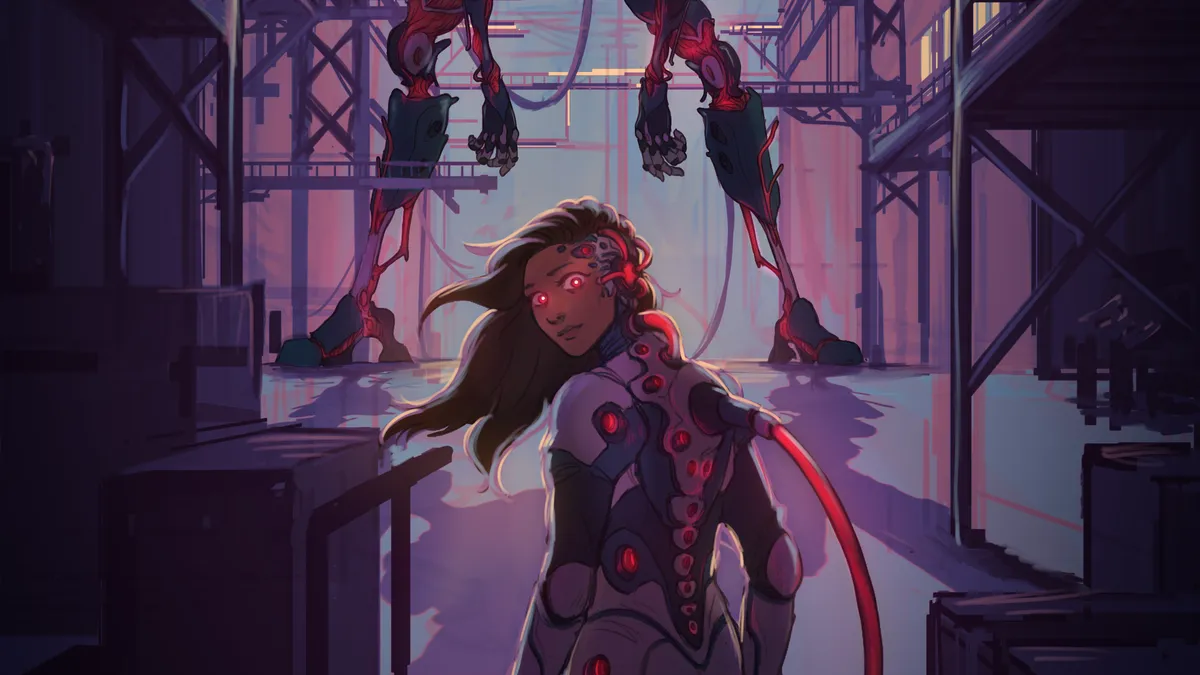
Illustration from girl frame ttrpg.
Tech Democracy
Tech consensus societies use ubiquitous information technology implants to facilitate direct democracy and/or consensus. Implanted individuals vote on dozens of small decisions each day, and choices are fed directly into algorithms to generate the next iteration of entertainment and consumer products. Prices for most goods are determined via consensus algorithms in real time.
Advantages
- Information Implant: Members can look up common information without needing a terminal. However the information may be unreliable.
- Consensus: Advantage to social interactions with other members.
- Trader: Members can use the implant to simplify complex calculations when trading or bartering. Bonus when trading, including interactions with non-members.
Appearance
- trendy hairstyle and makeup
Clothing
- consumable clothing, trendy clothing
Ethos
- Hypercapitalist
Character Questions
- How do you feel when disconnected from the network?
Notes
This is largely based on the Demarchists of Chasm City by Alistair Reynolds.